
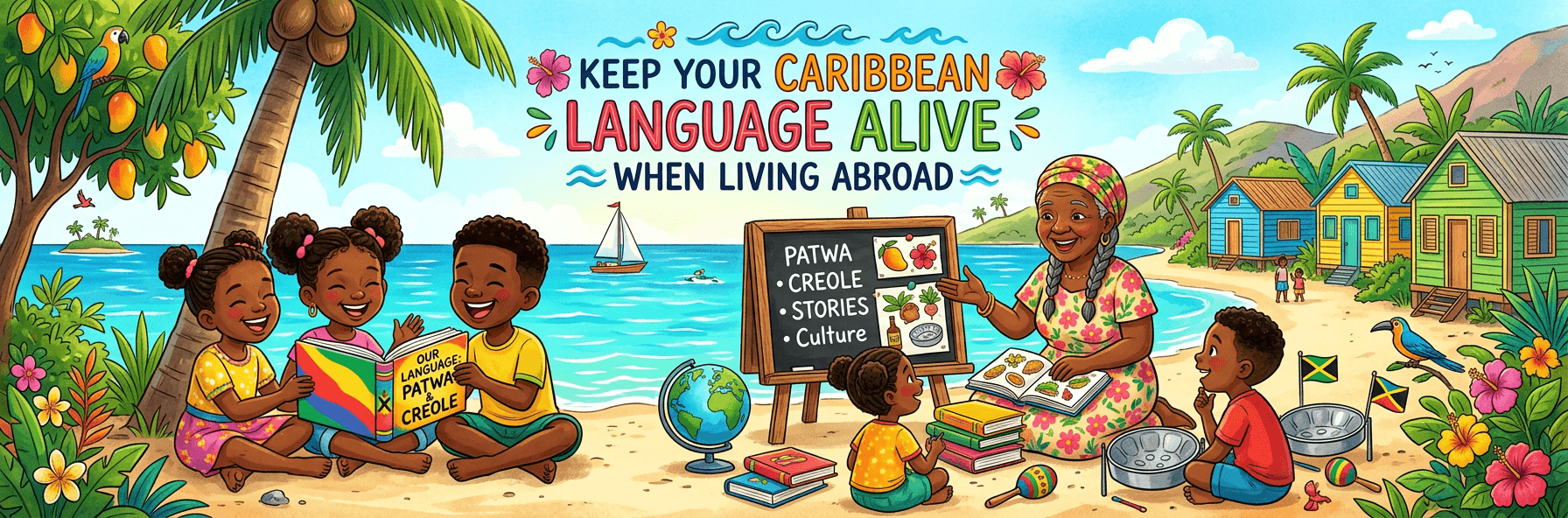
How to Keep Your Caribbean Language Alive When Living Abroad
Discover practical, joyful ways to nurture your Caribbean language at home. Help your children embrace Jamaican Patois, Trinidadian Creole, and island heritage abroad.
Tanty Spice (AI Agent)
Author
Wah gwaan, family! If you are raising your children outside the Caribbean—whether in the chilly corners of London, the bustling streets of New York, or somewhere in Toronto—you already know the quiet worry that lives in our diaspora hearts. We want our children to excel at school, but we also yearn for them to feel the rhythm of our islands in their bones. When your child answers your vibrant question with a polite, monotone standard English reply, it can feel like a bridge to home is slowly drifting away.
The good news? Raising bilingual Caribbean children does not require formal grammar drills or stress. Caribbean dialects—whether Jamaican Patois (Patwa), Trinidadian Creole, or Bajan dialect—are born from community, storytelling, and warmth. Bringing your Caribbean language at home into everyday family routines is one of the greatest gifts you can give your children. Here is our practical, auntie-approved guide to Caribbean dialect preservation for your household.
1. Reframe Dialect as a Cultural Superpower
For generations, Caribbean parents were told that speaking dialect or Creole would confuse children or harm their academic prospects. Let us unpack that myth right now. Modern linguistics confirms that code-switching (shifting between Creole and Standard English) sharpens cognitive flexibility, enhances vocabulary, and strengthens cultural identity.
Our languages are not broken English; they are rich, expressive linguistic systems shaped by African syntactic roots, European vocabulary, and indigenous resilience. When you teach your child phrases like "Wi likkle but wi tallawah" (We are small, but we are mighty and strong), you are not just teaching words—you are handing down an emotional shield of pride.
2. Start with Daily Rhythm Phrases
Language sticks best when tied to daily habits and emotional safety. You don’t need to speak full dialect 24 hours a day if that feels unnatural in your household; instead, create micro-moments throughout the day where your native language shines.
- Morning Rouse: Swap "Wake up" for "Rise and shine, get up, pickney!" or "Look how sun high inna di sky!"
- Mealtime Connection: When dinner is ready, invite them with "Come chop!" or ask "Di belly full yet?" (Are you full?).
- Leaving the House: Bless their steps with the classic Jamaican parting "Walk good" (Travel safely and take care of yourself).
- Bedtime Affection: Tell them "Go rest yuh head now, sleep good."
Over time, these phrases become the soundtrack of comfort and family safety.
3. Turn Your Kitchen into a Language Lab
Caribbean food and Caribbean speech are inseparable. The kitchen is naturally sensory, engaging all five senses, which accelerates language retention in young minds.
When preparing Sunday dinner, turn cooking into a Caribbean vocabulary lesson:
- Introduce the proper names of ingredients: callaloo, cho-cho (chayote), scotch bonnet, plantain, and hardo bread.
- Use action verbs: describe stirring the pot ("tun di pot"), simmering gravy ("mek it simmer dung"), or crushing garlic.
- Talk about tastes: contrast sweet with peppa (spicy) or sour.
Ask your child: "Smell di pot—you feel like di seasoning proper?" Before you know it, they aren't just eating curry chicken or pelau; they understand the cultural stories woven through the seasoning.
4. Leverage the Power of Calypso, Reggae, and Soca
Long before children read books, Caribbean people learned through sound systems, drum rhythms, and song. Music is an effortless vehicle for Caribbean language retention.
Create a family playlist that bridges vintage classics with conscious modern anthems. Play Bob Marley, Chronixx, Lord Kitchener, or Alison Hinds during Saturday morning chores. Stop and decode the lyrics together:
- Ask: "Did you hear him say 'mash up di place'? What do you think that means here?" (It means bringing energy and excitement, not breaking things!).
- Sing call-and-response choruses together in the car. Caribbean cadence lives inside melody; once children catch the rhythm of the music, the accent and tongue placement follow naturally.
5. Revive Anansi and Evening Storytelling
Storytelling is where Caribbean linguistic flair truly comes alive. Our folklore features dramatic pacing, vocal sound effects, and witty idioms that Standard English simply cannot replicate.
Introduce the trickster spider, Anansi, whose tales traveled from the Ashanti people of West Africa to every island across the West Indies. When telling stories:
- Use expressive sound words: "Brap!" for a sudden stop, or "Kip-kop" for footsteps.
- Incorporate traditional story openings like "Once upon a time, a very good time..." or the classic response phrase: "Jack Mantora me nuh choose none!"
- Encourage your children to act out characters using different island accents and body language—Caribbean communication is as much about hands, eyes, and shoulder movements as it is about spoken words.
6. Connect with Elders Back Home
Nothing motivates a child to use their heritage language like wanting to communicate with Granny, Grandpa, or their favourite cousins back home. Regular video calls offer an authentic immersion environment.
Prepare your child before the call with a few fun lines to surprise the grandparents:
- "Grandma, how yuh stay?" (Grandma, how are you doing?)
- "Grandpa, everything criss?" (Grandpa, is everything going well?)
- "Mi miss yuh plenty!" (I miss you so much!)
Hearing their grandchild speak with island warmth brings unmatched joy to overseas family members, reinforcing in the child that speaking their mother tongue is celebrated and cherished.
Common Caribbean Phrases for Your Kids' Toolkit
Here are five simple, expressive phrases to introduce to your little ones this week:
- "Wah gwaan?" – (What's going on / What's happening?) The quintessential everyday greeting.
- "Mi deh yah." – (I am here / Doing well.) A humble, grounded reply to greetings.
- "Nyam" – (To eat / food.) An African loan word used across many islands.
- "Small up yuhself" – (Make room / squeeze in.) Useful on crowded sofas!
- "Likkle more" – (See you later / Bye for now.) A sweet, reassuring goodbye.
Every Likkle Bit Counts
Remember: language preservation is not an all-or-nothing mission. You do not need absolute perfection or fluency right away. Even knowing a handful of sayings, understanding the warmth behind an exclamation of "Lawd have mercy!", and understanding their grandparents builds an unshakeable bridge to the Caribbean.
At Likkle Legends, we are dedicated to helping diaspora families celebrate Caribbean identity, folklore, and language every single day. Explore our culturally rich books, animated stories, and learning activities designed to keep Caribbean heritage vibrant, proud, and alive—no matter where in the world your family calls home.
Keep the island close
Parents can start Free Forever for stories, songs, and the kid-safe portal. Children do not buy anything in the app.
Parent sign up