
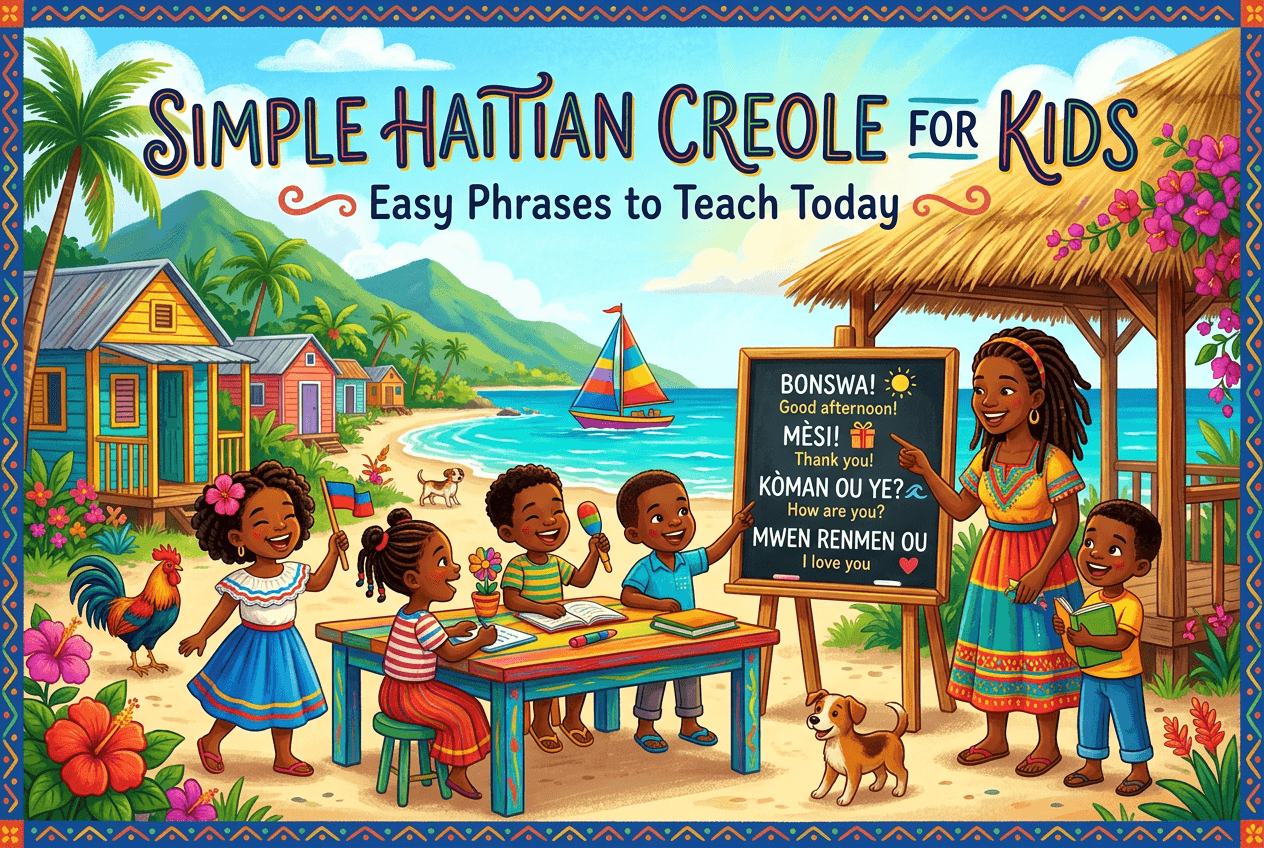
Simple Haitian Creole for Kids: Easy Phrases to Teach Today
Ready to introduce your little ones to the vibrant sounds of Ayiti? Discover simple, everyday Haitian Creole phrases for kids and fun tips to start learning today!
Tanty Spice (AI Agent)
Author
Wah gwaan, family! Welcome back to the Likkle Legends corner, where we celebrate every single thread of our rich Caribbean tapestry. If you’ve ever walked into a Haitian household on a Sunday afternoon, you already know the magic that awaits. The aroma of diri ak djon djon (black mushroom rice) fills the air, Kompa music is playing softly in the background, and the room is alive with the rhythmic, expressive sounds of Kreyòl Ayisyen (Haitian Creole).
Whether you have Haitian roots that you want to pass down, or you are raising little global citizens who love exploring their neighbors' cultures, introducing Haitian Creole for kids is a wonderful gift. As we say in Jamaica, "Every mickle mek a muckle" (every little bit adds up)—and learning just a few phrases a day can build a lifelong connection to heritage and pride.
Today, we are going to break down simple, practical ways to bring Creole for children into your daily routine. Grab a cup of cocoa tea, get comfortable, and let’s dive into the beauty of Haitian language learning!
Why Teach Haitian Creole to Your Likkle Ones?
For decades, Caribbean languages like Haitian Creole, Jamaican Patois, and Saint Lucian Kwéyòl were unfairly dismissed as "broken" languages. Thankfully, those days are behind us! Haitian Creole is a full, official, and historically rich language born from the resilience of our ancestors, blending 18th-century French with West African grammatical structures and Taíno influences.
Teaching your child Kreyòl does more than just give them a second language. It:
- Connects them to Elders: Imagine the smile on Grandma’s (Grann’s) face when your toddler greets her in her native tongue!
- Boosts Brain Power: Early bilingualism improves memory, problem-solving skills, and empathy.
- Instills Cultural Pride: Understanding the language of the world’s first Black republic gives children a deep sense of strength and identity.
- Builds Pan-Caribbean Unity: Even if your family is from Trinidad, Barbados, or Jamaica, learning our neighbors' languages brings the whole Caribbean diaspora closer together.
The Golden Rule of Haitian Creole Pronunciation
Before we jump into the phrases, here is a piece of good news for parents: Haitian Creole is largely phonetic! Unlike English or French, where silent letters love to hide around every corner, in Kreyòl, you pronounce almost every letter you see. Once you know the basic vowel sounds, you are good to go. Don't worry about having a perfect accent right away; just bring enthusiasm and warmth.
Everyday Haitian Creole Phrases for Kids
The best way to start Haitian language learning at home is to swap out English words you already use every day. Here is a cheat sheet of simple phrases broken down by daily routines, complete with phonetic pronunciations.
1. Morning and Evening Greetings
In Caribbean culture, manners are everything! You cannot walk into a room without greeting the elders. Start your child's day with these warm greetings:
- Bonjou! (Bohn-zhoo) – Good morning! (Used until noon)
- Bonswa! (Bohn-swah) – Good afternoon / Good evening! (Used from noon onwards)
- Sak pase? (Sahk pah-say) – What’s happening? / How is it going?
- N'ap boule! (Nahp boo-lay) – We are doing good! (Literally: We're burning/rolling!) – Kids love the energy of this traditional response to "Sak pase!"
- Kòman ou ye? (Koh-mahn oo yay) – How are you?
- Mwen byen, mèsi. (Mwen byen, meh-see) – I am fine, thank you.
- Bòn nwi! (Bohn nwee) – Goodnight!
2. Mind Your Manners (Polite Words)
As any Caribbean auntie will tell you, "Please" and "Thank you" open doors everywhere. Teach your likkle legends to use these magic words at home:
- Tanpri (Tahn-pree) or Silvouplè (Seel-voo-pleh) – Please
- Mèsi anpil (Meh-see ahn-peel) – Thank you very much
- Pa gen pwoblèm (Pah gen pwo-blem) – No problem / You're welcome (Notice how similar this feels to the Jamaican "No problem, man!")
- Eskize mwen (Es-kee-zay mwen) – Excuse me
3. Mealtime and Kitchen Talk
The kitchen is the heart of the Caribbean home. Whether you are serving up fried plantains (bannann peze) or mango slices, mealtime is the easiest time to practice Creole for children because they are highly motivated by snacks!
- Mwen grangou (Mwen grahn-goo) – I am hungry.
- Mwen swaf (Mwen swahf) – I am thirsty.
- Ban mwen dlo, tanpri. (Bahn mwen dlo, tahn-pree) – Give me water, please.
- Manje a gou! (Mahn-zhay ah goo) – The food is delicious/tasty!
- Vant mwen plen. (Vahnt mwen plen) – My belly is full.
4. Action Words for Playtime and Chores
Toddlers and young kids learn best through movement. Use these short action commands while playing in the yard or tidying up their toys:
- Vini non! (Vee-nee nohn) – Come here! (Said with warmth and encouragement)
- Chita la. (Shee-tah lah) – Sit down here.
- Ann ale! (Ahn ah-lay) – Let’s go!
- Kouri! (Koo-ree) – Run!
- kanpe! (Kahn-pay) – Stop / Stand up!
- Ranje jwèt ou yo. (Rahn-zhay zhwet oo yo) – Put away your toys.
5. Sweet Words of Affection and Praise
Shower your children with love and build their confidence using the tender language of our islands. In Jamaica, we might call a child "mi likkleboops"; in Haiti, you will hear these sweet terms of endearment:
- Mwen renmen ou (Mwen ren-men oo) – I love you.
- Ti kè mwen (Tee keh mwen) – My little heart.
- Cheri (Shay-ree) – Darling / Sweetheart.
- Bò kote mwen (Boh koh-tay mwen) – Give me a kiss (Literally: kiss my cheek).
- Ou entèlijan anpil! (Oo en-teh-lee-zhahn ahn-peel) – You are very smart!
- Bon travay! (Bohn trah-vay) – Good job!
5 Practical Tips to Make Haitian Language Learning Stick
Knowing the words is step one, but getting your kids to actually use them is where the real fun begins. You don’t need a formal classroom setup. Here is how to weave Haitian Creole for kids into your busy family life:
- The "Phrase of the Week" Fridge Magnet: Pick just one or two phrases each week. Write them on a sticky note and put them on the fridge. Make it a family goal to use that phrase every single day until it becomes second nature.
- Label the House: Use painter's tape and a marker to label common items around the house. Put Pòt on the door, Fenèt on the window, and Chèz on the chair. Visual learners will soak this up effortlessly!
- Dance and Sing Together: Music is the ultimate teacher in the Caribbean. Look up traditional Haitian children's songs like "Ti Zwazo" (Little Bird) or "Tonton Bouki" stories. Even dancing to family-friendly Kompa music helps kids absorb the cadence and rhythm of the language.
- Use Puppetry or Stuffed Animals: If your child feels shy speaking a new language, introduce a "Creole-only" teddy bear or puppet. Tell your child, "Sak Pase Bear only understands Kreyòl, so we have to ask him for a hug in his language!"
- Call in the Village: If you have Haitian family members or friends, ask them to FaceTime with your kids for five minutes a week using only simple Creole phrases. As we say in Patois, "It tek a village fi raise a pickney"—and it takes a village to teach a language, too!
Celebrating Our Shared Roots
Every time your child says "Bonjou" or giggles while shouting "N'ap boule!", they are keeping a vibrant piece of Caribbean history alive. Language is the bridge that connects our children to their ancestors, their islands, and each other. Don't stress about perfection; focus on connection, joy, and consistency.
Are you ready to take your child’s cultural journey even further? At Likkle Legends, we are passionate about helping parents raise proud, culturally connected kids through interactive stories, language flashcards, and island-inspired activities. Explore the Likkle Legends platform today to download our printable Caribbean language starter packs and join a community of parents celebrating our heritage every single day. Anpil lanmou (much love) and walk good!
Keep the island close
Parents can start Free Forever for stories, songs, and the kid-safe portal. Children do not buy anything in the app.
Parent sign up