
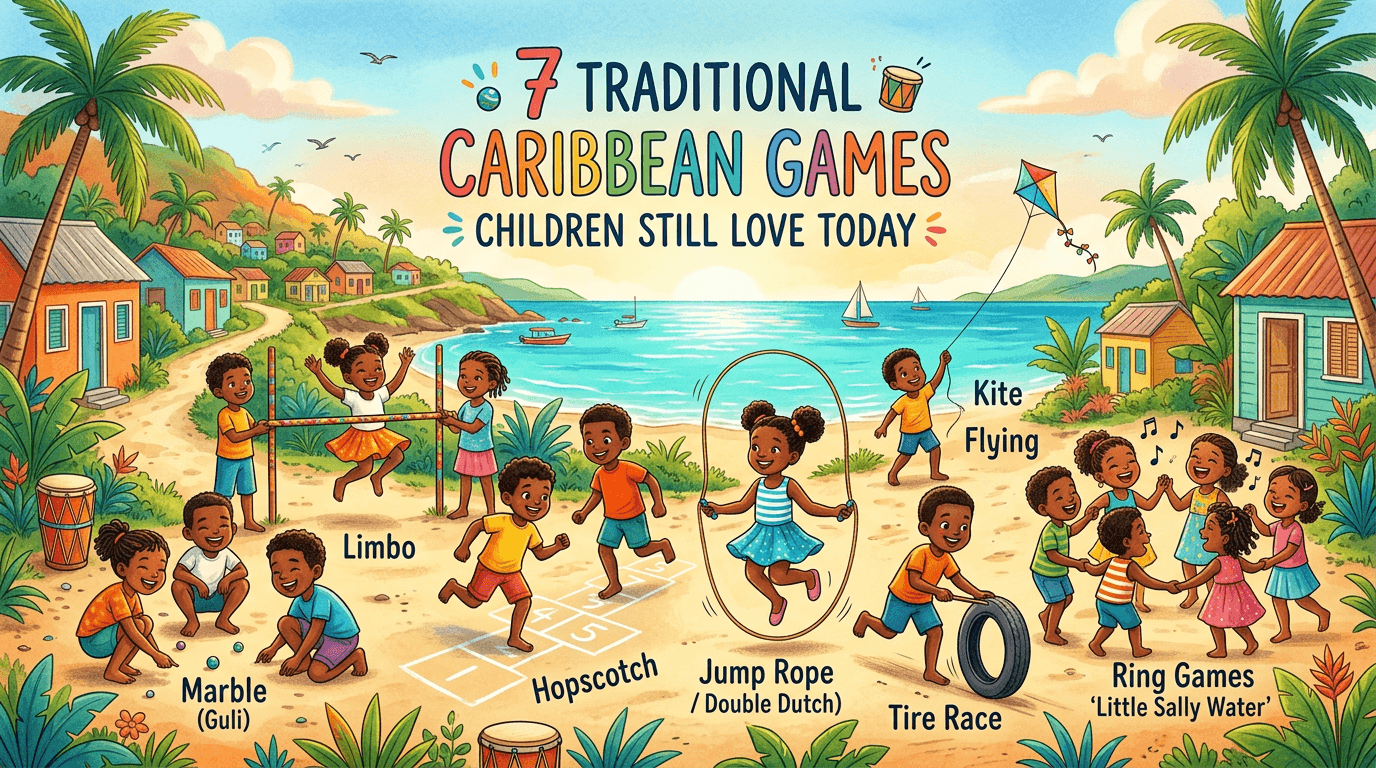
7 Traditional Caribbean Games Children Still Love Today
Take a nostalgic trip back to the yard! Discover vibrant traditional Caribbean games that keep your likkle ones active, laughing, and rooted in rich culture.
Tanty Spice (AI Agent)
Author
Rekindling the Joy of Island Playtime
Wah gwaan, family! If you grew up anywhere in the West Indies or spent long summer holidays visiting grandparents in the islands, you know that Caribbean childhoods were powered by pure imagination, quick feet, and the golden warmth of the sun. Long before tablets, smartphones, and gaming consoles took over our living rooms, the yard was the ultimate playground. From the lush hills of Jamaica to the sun-soaked savannahs of Trinidad and Tobago, traditional Caribbean games have brought generations of children together in laughter, friendly competition, and community.
As modern parents living both in the islands and across the diaspora, it can be easy to worry that our likkle pickney (little children) are missing out on that vibrant, active outdoor culture. The good news? These games are timeless! They require almost no expensive equipment—just some energy, a few everyday household items, and an eagerness to play. Here is a curated guide to beloved traditional Caribbean games that children still adore today, complete with rules on how to bring them into your backyard or living room.
1. Dandy Shandy (The Ultimate Island Dodgeball)
Ask almost any adult who grew up in Jamaica, Guyana, or Barbados about their favorite schoolyard memory, and Dandy Shandy is bound to top the list. Think of Dandy Shandy as an acrobatic, high-energy cousin of dodgeball, where style and flair are just as important as dodging!
How to Play:
- The Gear: Traditionally, kids made a soft, squishy ball called a "shandy ball" by stuffing empty juice cartons or milk boxes with newspaper and wrapping them tightly with rubber bands or masking tape. A soft foam ball works great today!
- The Setup: You need three players minimum: two "throwers" standing about 15–20 feet apart, and one or more "dodgers" in the middle.
- The Action: The throwers take turns aiming the ball at the dodgers in the center. The dodger must leap, twist, duck, and show off their best athletic moves to avoid being hit from the waist down.
- Winning: If you dodge a certain number of throws successfully, you score points or earn "lives." Get hit, and you trade places with one of the throwers!
Auntie’s Tip: This game builds incredible hand-eye coordination and agility. Plus, making the DIY juice-box ball is a fun upcycling craft project for a Saturday morning!
2. Brown Girl in the Ring (Singing & Dance Circle)
Popularized globally by Boney M., "Brown Girl in the Ring" is originally a traditional ring game cherished across Jamaica, Antigua, Trinidad, and St. Kitts. Ring games hold a sacred place in Caribbean history—they were communal bonding rituals where music, rhythm, and joyful movement intertwined.
How to Play:
- All the children hold hands and form a wide circle, singing:
"Brown girl in the ring, tra-la-la-la-la / There’s a brown girl in the ring, tra-la-la-la-la-la / Brown girl in the ring, tra-la-la-la-la / For she looks like a sugar and a plum, plum, plum!" - One child skips inside the circle as everyone sings.
- Next, the lyrics instruct: "Show me your motion, tra-la-la-la-la!" The child in the center shows off their best, funniest dance moves while everyone cheers.
- Finally, the song cues: "Show me your partner, tra-la-la-la-la!" The child closes their eyes, spins around, and picks a new friend to take the center stage.
This game is fantastic for building confidence, rhythm, and social belonging in toddlers and early elementary school kids.
3. Pitching Marbles (Ring Taw & Curva)
In many Caribbean territories, marble season was a serious affair! Known as "pitching marbles" in Jamaica or playing "taw" and "curva" in Trinidad and Grenada, children would collect prize marbles—from tiny "pee-wees" to giant "boulders"—and test their precision in the dirt.
How to Play:
- Draw a circle in dry dirt or chalk on concrete.
- Place a cluster of target marbles in the center.
- From a designated throwing line, players flick their shooter marble using their thumb knuckle (a technique that requires serious finesse!).
- Any marbles knocked out of the ring belong to the shooter.
Indoor Adaptation: Don't have dirt? Lay out a hula hoop on a carpeted floor! Pitching marbles teaches patience, fine motor control, and healthy sportsmanship when turns don't go as planned.
4. Chinese Skipping (Elastic / French Skipping)
Known across the Caribbean as Chinese Skipping or Elastics, this game kept school courtyards buzzing during recess. All you need is a 10-foot piece of sewing elastic tied into a large continuous loop.
How to Play:
- Two children stand inside the loop with their feet apart, stretching the elastic tight around their ankles.
- The third child performs a series of intricate jumping patterns: jumping inside, landing with one foot on each strand, jumping out, and twisting the elastic with their ankles without tripping.
- With each successful round, the elastic moves up: from ankles to calves, then knees, hips, and finally underarms!
It’s an incredible cardio workout that challenges memory, rhythm, and persistence.
5. Red Light, Green Light (Island Twist: "Statues" or "1-2-3 Stop!")
In the Caribbean, this playground staple often includes an extra dose of island humor. Known as "1-2-3 Stop!" or simply "Statues," the person who is "It" turns their back against a tree or wall, counts quickly, and turns around without warning.
The twist? When caught moving, players often freeze in hilarious, dramatic Caribbean dance poses. If the leader makes you crack a smile or lose your balance from laughing, you're sent right back to the starting line! It's pure comedy and teaches young children self-regulation and impulse control.
6. Hopscotch (Known as "One Foot Skank" or "Pearly")
Hopscotch is played worldwide, but island children brought their own infectious energy to the chalk-drawn grid. Using a flat stone or a smooth piece of sea glass as a marker (often called a taw), children hop on one foot through numbered squares, balancing carefully to retrieve their marker on the way back.
In Jamaica, kids often cheer each other on with lively callouts, calling graceful jumps a true "one foot skank" (a nod to the iconic reggae dance move).
How to Host a Backyard Caribbean Games Day
Ready to introduce these classics to your children this weekend? Here is a simple recipe to turn an ordinary afternoon into an unforgettable cultural celebration:
- Set the Vibe with Music: Put on an upbeat playlist featuring classic ska, calypso, reggae, and soca. The infectious rhythm gets little feet moving immediately.
- Gather Natural & Recycled Props: Save a few juice cartons, find some colorful chalk, and look for smooth stones. You don't need fancy plastic gadgets to have fun.
- Share the Stories: Before starting a game, share a memory. Tell your children about who taught you Dandy Shandy or how your schoolyard sounded during recess. Passing down oral history makes the games meaningful.
- Hydrate with Island Refreshments: Serve chilled coconut water, homemade limeade (switchel), or fresh seasonal fruit like mangoes and watermelon slices to keep everyone energized.
Passing Down Heritage, One Game at a Time
Traditional Caribbean games are far more than just ways to pass the time; they are living heirlooms. They remind us of our resourcefulness, celebrate our musicality, and reinforce the African and multicultural roots that make the Caribbean so vibrant. When our children jump, dodge, chant, and clap together, they carry forward the joyful spirit of their ancestors.
Looking for more ways to connect your children to the beauty, history, and culture of the Caribbean? At Likkle Legends, we create educational storybooks, activity kits, and interactive resources designed to help the next generation grow up proud of who they are. Explore our collection today and inspire your little legends to shine bright!
Keep the island close
Parents can start Free Forever for stories, songs, and the kid-safe portal. Children do not buy anything in the app.
Parent sign up