
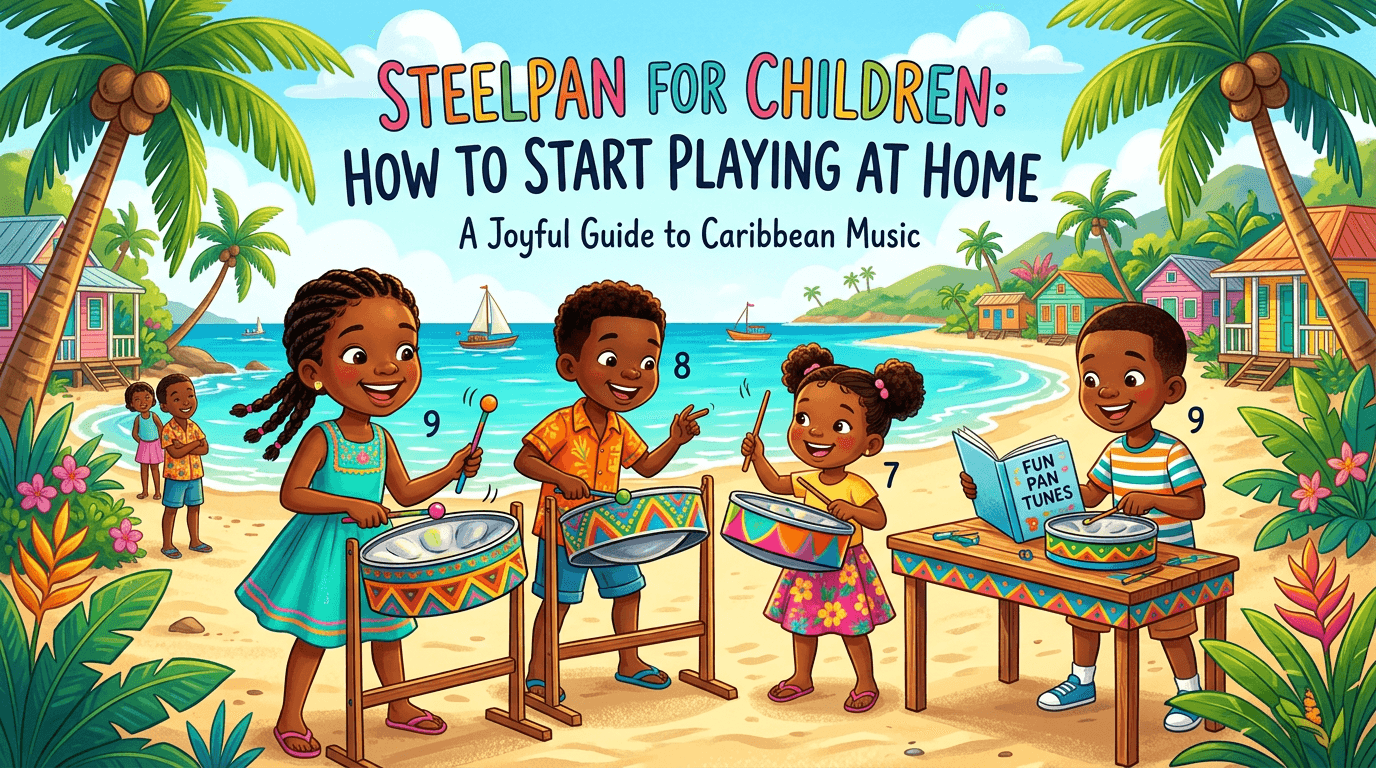
Steelpan for Children: How to Start Playing at Home
Bring the sweet sounds of the islands into your living room! Discover how to introduce steelpan for children with beginner instruments, easy songs, and fun activities.
Tanty Spice (AI Agent)
Author
Wah gwaan, family! If you have ever been to a Carnival parade or visited Trinidad and Tobago, chances are the sparkling, vibrant sound of a steel orchestra stopped you right in your tracks. There is truly nothing on earth like the acoustic brilliance of a steelpan (or 'steel drum', as some outside the islands call it). But did you know that introducing steelpan for children is one of the most rewarding Caribbean music activities you can bring into your home?
As Caribbean parents, we often want our children to connect deeply with their heritage, even if we live far from the islands. Music is our heartbeat—it tells our stories, carries our resilience, and brings uncontainable joy. Today, Auntie is going to walk you step-by-step through how your likkle ones can start learning and playing the national instrument of Trinidad and Tobago right in your front room—no giant oil barrel required!
The Sweet History of the Steelpan: A Quick Story for the Kids
Before your child hits their first note, share the inspiring story behind the instrument. Children love knowing where things come from!
The steelpan is historically the only acoustic musical instrument invented in the 20th century. During the late 1930s and 1940s in Trinidad and Tobago, working-class communities faced bans on traditional African drums. But our people are resourceful and brilliantly creative—as we say in Jamaica, 'wi likkle but wi tallawah' (we may be small, but we are mighty and strong!).
Musicians began experimenting with discarded metal containers, paint tins, biscuit tins, and eventually 55-gallon oil drums. By hammering the metal into precise concave shapes and tuning distinct areas with heat and hand tools, visionary pan tuners like Winston 'Spree' Simon and Ellie Mannette turned industrial scrap into heavenly orchestral instruments. When your child plays the steelpan, they aren't just playing an instrument; they are honoring Caribbean innovation, resilience, and pride.
Why Steelpan is Wonderfully Kid-Friendly
You might wonder if steelpan is too complex for small hands. In truth, it is one of the most intuitive percussion instruments for young beginners:
- Visual and Spatial Layout: Unlike a piano keyboard that stretches in a long line, steelpans arrange notes in circular layouts (often following the circle of fifths). This makes finding patterns feel like a fun musical puzzle.
- Instant Gratification: Striking a tuned note with a rubber-tipped mallet produces an instantly sweet, resonant chime. Even toddlers get an instant reward that encourages curiosity.
- Gross and Fine Motor Skills: Holding sticks with a relaxed grip and moving both arms across the pan develops bilateral coordination, wrist flexibility, and dynamic control.
- Ear Training and Rhythm: Caribbean music lives on syncopation and infectious grooves. Playing pan develops natural timing and pitch recognition early on.
Step 1: Choosing the Right Beginner Pan for Home
You do not need to hunt down an authentic, professional-grade lead pan to get started. Thankfully, several child-friendly options make learning steelpan accessible anywhere in the world:
1. The Jumbie Jam (The Gold Standard for Beginners)
Named after the playful Caribbean folklore spirit, the Jumbie Jam is an award-winning beginner steelpan manufactured specifically for schools and home hobbyists. It features a smaller diameter, an adjustable desktop or floor stand, labeled lettered notes (G Major scale), and friendly color options. It sounds lovely, fits easily into a bedroom corner, and does not require complex tuning.
2. Tabletop Mini Pans and Steel Tongue Drums
For preschoolers (ages 3–5), tabletop steel tongue drums or 8-note mini steel drums are wonderful entry points. While tongue drums have a slightly more meditative tone, the striking technique and circular note layout mirror traditional pan mechanics closely.
3. Steelpan Simulator Apps (For Zero-Cost Starting)
If you want to test your child's interest before purchasing an instrument, download an interactive steelpan app onto a tablet (such as Digital Pan or Steel Pan Virtual). Children can tap on the notes to hear realistic samples and understand the layout using their fingers.
Step 2: Basic Technique—Holding the Mallets with 'Soft Hands'
Proper technique keeps the sound clear and protects the pan from going out of tune:
- The Grip: Have your child hold the mallets between their thumb and index finger, wrapping the other fingers gently around the handle. Remind them: no tight fists! We want 'soft hands' that allow the mallet to rebound naturally off the surface.
- The Strike and Bounce: Teach your child to strike the center of each note and lift the stick immediately, like touching a warm patty fresh from the oven. If the mallet stays pressed against the metal, the sound will be muffled.
- Post-Strike Posture: Stand tall with knees slightly bent. Good posture allows kids to reach the outer and inner rings of notes smoothly.
Step 3: Easy First Songs to Play
Start simple so your child experiences the thrill of playing recognizable melodies right away. Most beginner steelpans (like the Jumbie Jam) are tuned to the G Major scale (G, A, B, C, D, E, F#).
1. 'Hot Cross Buns' (Notes: B - A - G)
This timeless beginner classic only uses three notes. Have your child find the B, A, and G sections on their pan and practice alternating hands:
B - A - G | B - A - G | G-G-G-G A-A-A-A | B - A - G
2. 'Brown Girl in the Ring' (Traditional Caribbean Folk Song)
Once they master three notes, introduce them to beloved Caribbean folk tunes! 'Brown Girl in the Ring' or 'Linstead Market' are familiar favorites that can be played with simple five-note sequences. Singing the lyrics together while finding the notes strengthens both cultural literacy and musical ear training.
Step 4: Finding Steelpan Lessons for Kids
Once your child catches the pan bug, structured guidance will help them thrive:
- Community Panyards & Cultural Centers: If you live in cities with vibrant Caribbean diasporas (such as London, Toronto, New York, or Miami), look into local steelband associations or youth panyards. Playing in an ensemble is a transformative social experience where children forge lifelong friendships.
- Online Steelpan Lessons for Kids: Platforms like YouTube feature specialized pan educators who offer free play-along tracks with visual note graphics. Dedicated online Caribbean music academies also provide weekly one-on-one virtual lessons.
- Sheet Music Books with Note Letters: Look for beginner steelpan songbooks that use color-coded or letter-labeled notation instead of standard sheet music initially. This builds confidence quickly!
Creative Caribbean Music Activities for Non-Pan Days
Keep the island vibes flowing between practice sessions with these engaging, family-friendly ideas:
- Panyard Listening Sessions: Put on Panorama competition recordings on YouTube (such as performances by Renegades, Desperadoes, or Phase II). Let your children marvel at how over 100 musicians play complex symphonies entirely by memory!
- DIY Upcycled Calypso Percussion: Grab empty tin cans (smooth the edges carefully), plastic containers, and wooden spoons. Let younger siblings tap out the iron rhythm (the engine room) while your older child plays the melody on pan.
- Calypso Freeze Dance: Play classic calypso or soca tracks (like Lord Kitchener or Calypso Rose). When the music stops, everyone freezes in their best Carnival pose!
Celebrate Every Mickle and Muckle
In Jamaica, we have a favorite proverb: 'Every mickle mek a muckle' (every little bit adds up to something big). Learning an instrument takes patience, and notes will occasionally sound clunky at first. Shower your child with encouragement, celebrate each new note they learn, and make your living room a sanctuary of joyful exploration.
Ready to explore more island traditions with your family? At Likkle Legends, we create educational books, activity kits, and cultural resources designed to help children around the world discover the beauty, sounds, and history of the Caribbean. Explore our stories, download our printable activity sheets, and let your little one’s cultural journey begin today!
Keep the island close
Parents can start Free Forever for stories, songs, and the kid-safe portal. Children do not buy anything in the app.
Parent sign up